

Destructure In Javascript
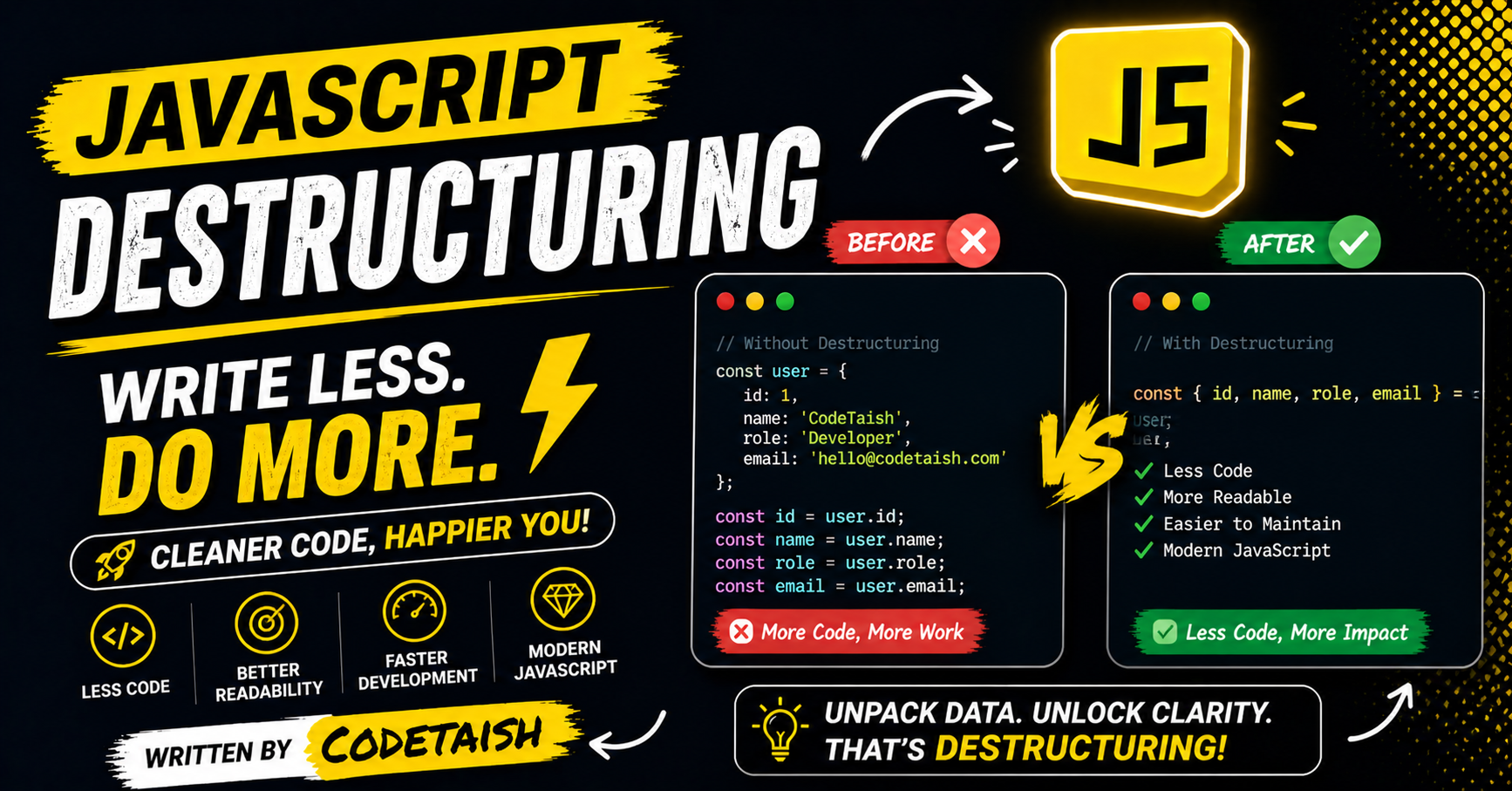
In this article, we are going to explore a unique feature of the javascript in which we can open and get the data inside the collection of the object.
this feature is used in every programming language where we can extract all the data inside the complex object and stored it in the particular jars(container/ variable)
Destructuring
Destructuring assignment is a JavaScript feature introduced in ES6 (ECMAScript 2015) that allows you to extract values from arrays or properties from objects into distinct variables using concise, pattern-based syntax. It works by unpacking data on the left-hand side of an assignment, effectively reversing the process of creating array or object literals.
This capability simplifies code by enabling multiple variable declarations and assignments in a single statement. It supports advanced features like swapping values without a temporary variable, skipping elements via commas, and using the rest syntax (...) to capture remaining items into a new array. Destructuring can be applied to iterables (such as strings, sets, and Maps) as well as nested structures, and it allows assigning values to new variable names different from the original property keys.
Key characteristics include:
Array Destructuring: Extracts values by position, e.g.,
const [a, b] = [10, 20]setsato 10 andbto 20.Object Destructuring: Extracts values by key, e.g.,
const { first, last } = { first: 'Jane', last: 'Doe' }.Default Values: Variables can be assigned defaults if the extracted value is
undefined, e.g.,const [a, b = 20] = [10].Error Handling: Attempting to destructure
nullorundefinedthrows a TypeError, whereas object destructuring coerces primitives to wrapper objects.Rest Syntax: The
...operator collects remaining elements into an array, e.g.,const [first, ...rest] = [1, 2, 3, 4].
Array Destructuring
Array destructuring is a JavaScript syntax that allows you to unpack values from arrays into distinct variables, making code more concise and readable. It works by placing variables inside square brackets on the left side of an assignment, matching them to the array elements on the right side.
Key features include:
Basic Extraction:
const [a, b] = [1, 2];assigns1toaand2tob.Skipping Elements: Use commas to skip values, such as
const [first, , third] = ["A", "B", "C"];to get"A"and"C".Rest Elements: The spread operator (
...) collects remaining items into a new array, e.g.,const [first, ...rest] = [1, 2, 3];results inrestbeing[2, 3].Default Values: Assign defaults for missing or
undefinedvalues, likeconst [a = 10, b = 20] = [1];wherebbecomes20.Swapping Values: Two variables can be swapped in a single line:
[x, y] = [y, x];.Function Parameters: Destructuring can be used directly in function arguments, such as
function log([first, second]) { ... }.
Object Destructuring
Object destructuring in JavaScript is an ES6 feature that allows you to extract properties from an object and assign them to variables in a single, concise statement. The basic syntax uses curly braces on the left side of the assignment to match property names: const { name, age } = person;.
This approach eliminates the need for repetitive code like const name = person.name; and supports advanced capabilities such as renaming variables (aliases), setting default values for missing properties, and accessing nested objects.
Renaming: You can assign a property to a variable with a different name using the syntax
const { propertyName: aliasName } = object;.Default Values: If a property does not exist, you can provide a fallback value like
const { country = "USA" } = person;.Nested Objects: You can extract deep values by chaining curly braces, for example,
const { address: { city } } = hero;.Function Parameters: Destructuring can be applied directly to function arguments to unpack object data immediately, such as
function({ name, age }) { ... }.Dynamic Properties: You can extract properties with dynamic names using computed property names:
const { [propName]: identifier } = expression;.
Key advantages include:
Concise Syntax: It eliminates the need for verbose assignments like
const name =person.name;by enablingconst { name } = person;.Variable Swapping: It allows swapping two variables without a temporary variable using
[a, b] = [b, a];.Default Values: It supports assigning default values when a property is missing or
undefined, such asconst { role = "Guest" } = user;.Immutable Operations: It facilitates immutable data manipulation, such as removing properties from objects or skipping array items, using the rest operator (
...).Improved Performance: It can improve code efficiency by avoiding unnecessary copying or looping over data structures.
Additionally, destructuring aids in parameter passing for functions, allows dynamic property access using computed property names, and supports nested structures for deeply nested data. It makes code more expressive and declarative, clearly showing which data parts are of interest and reducing the risk of typos.
Conclusion
Destructuring is a compact, expressive feature introduced in ES6 that makes extracting values from arrays, objects, and other iterables both readable and concise. By allowing pattern-based unpacking, it reduces boilerplate for common tasks—assigning defaults, renaming properties, pulling nested values, swapping variables, and gathering remainder elements with the rest syntax (...). For example, const [a, b] = arr, const { x: newName = 0 } = obj, and const { a, ...rest } = obj show how destructuring improves clarity and intent.
When used judiciously, destructuring enhances maintainability and reduces code verbosity. Be mindful of pitfalls: accessing deeply nested properties can produce undefined if intermediate values are missing, and overly complex patterns can hurt readability. Prefer clear defaults, concise nesting, and destructure only what you need.
Key takeaways:
Use array destructuring for position-based extraction and object destructuring for key-based extraction.
Use defaults and renaming to make code robust and self-documenting.
Apply rest syntax to capture remaining items cleanly.
Avoid over-destructuring deeply nested structures—consider helper functions or optional chaining.
Mastering destructuring leads to cleaner, more idiomatic JavaScript and helps keep your code expressive and easier to reason about.


